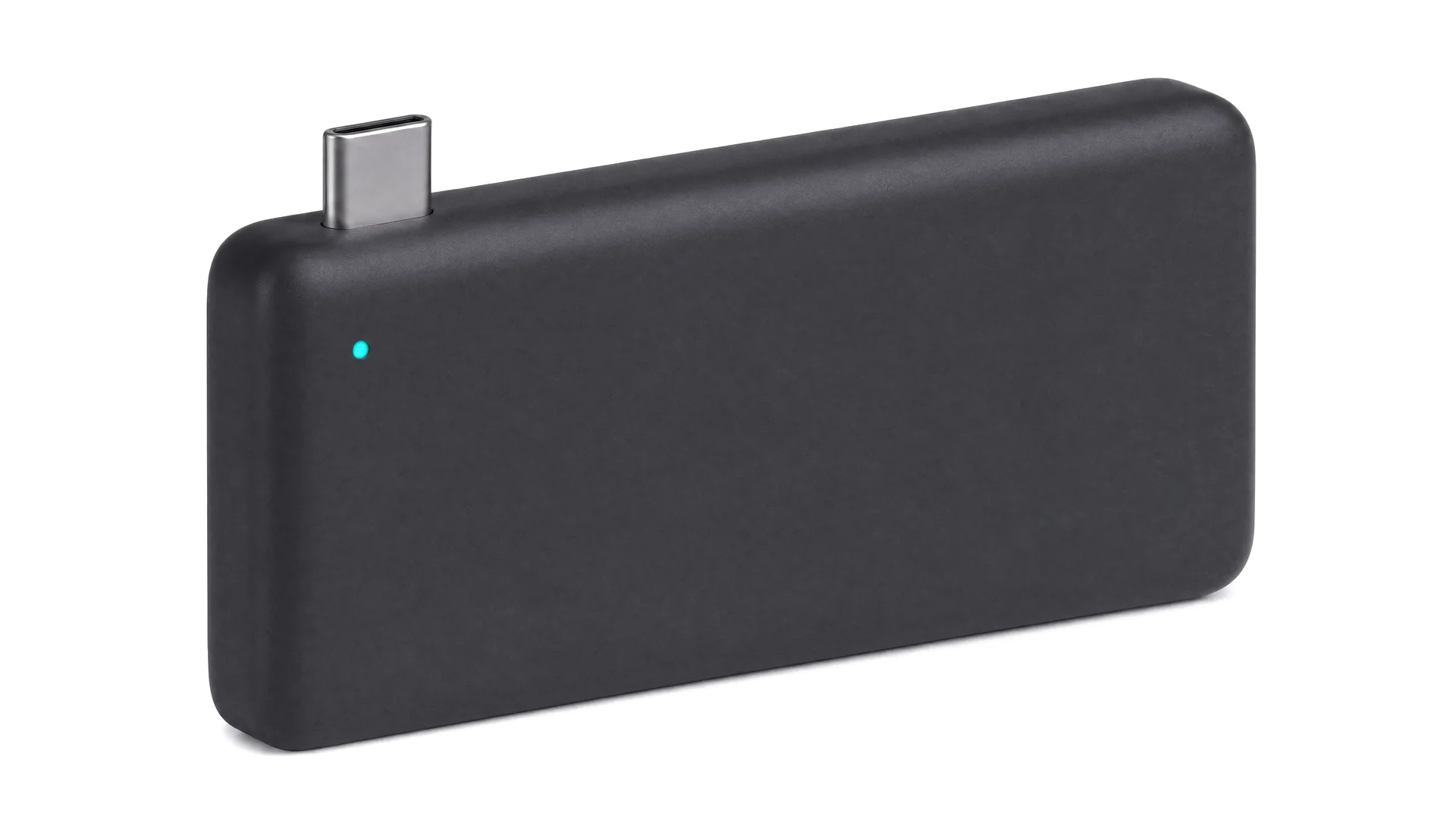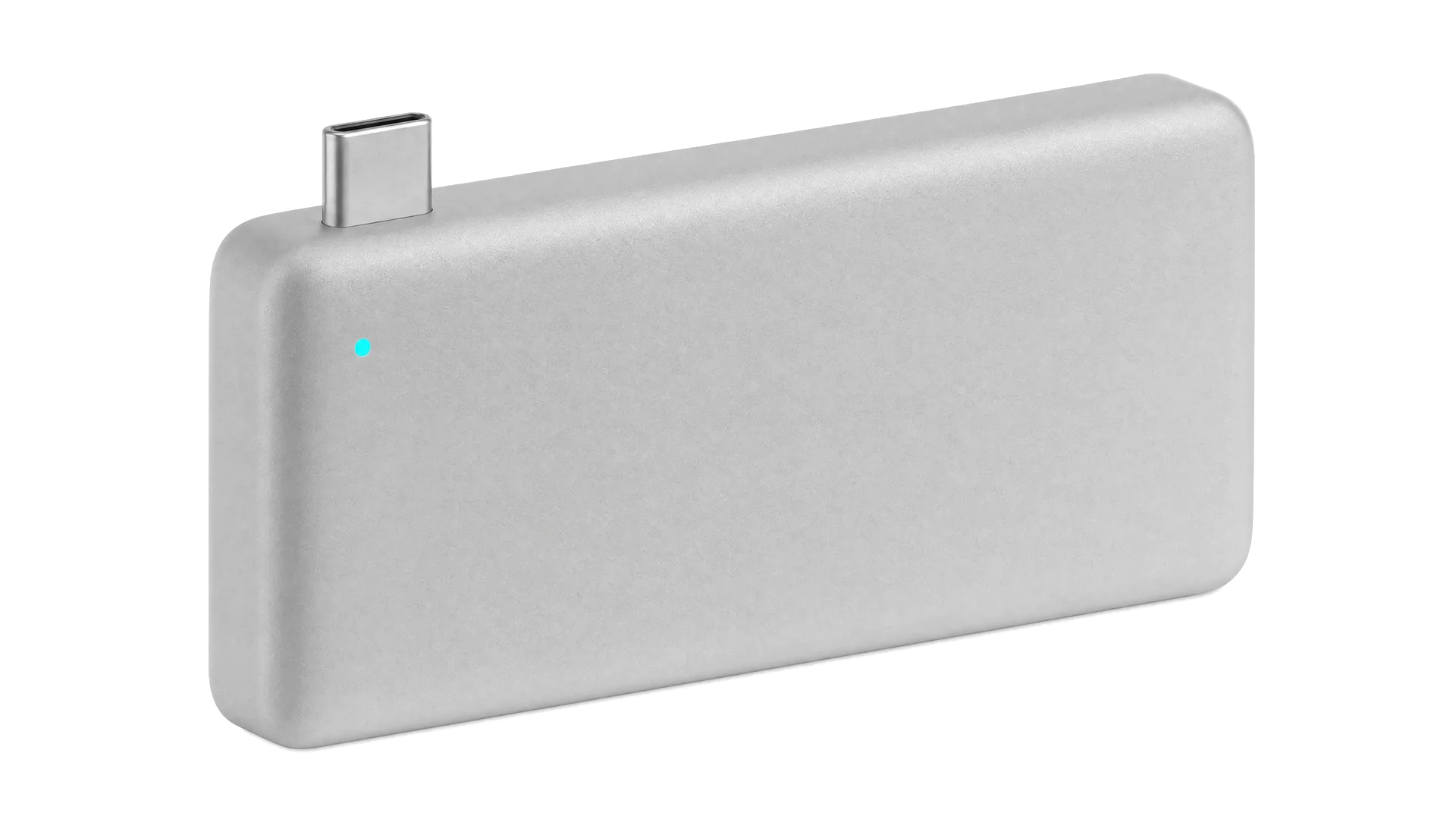
The radio, unbundled.
A USB-C 5G card for any MacBook with a USB-C port. Bus-powered, ethernet-native, nothing to install. 70 × 35 × 7 mm. 22 grams. $199 — and reservations are free.
silver and space black — matched to the MacBooks they'll sit beside. same matte soft-touch shell, same single SKU, same price. pick the one that matches, or the one that contrasts.
Measured in millimeters. And grams. And seconds.
Small enough to live on the side of your Mac and disappear into a pocket after. There's no battery inside — your MacBook is the battery, and Relay draws under 4.5 W from the bus at peak. That's most of why it's this small.
plug to online
Six parts. No screws. No vents. One light.
- 01USB-C male · USB 2.0 data
- 02link LED · 5 states
- 03nano-SIM tray · far end
- 04dual PIFA array beneath
- 05passive thermal spreader
- 06welded seam · no screws
Press-fit, ultrasonically welded.
Two PC/ABS halves bonded around the modem and antenna assembly. No visible fasteners, no glue migration, no warranty stickers — and no way in that doesn't end the device.
Passive, silent, sealed.
The enclosure is designed to spread modem heat across its full surface and stay warm-to-the-touch under sustained load. No fan, no vent. Measured thermal numbers will be published as we finish validation.
Dual PIFA in 7 mm.
Two planar inverted-F antennas tuned for sub-3 GHz and high-band 5G NR — the hardest engineering in the product is making them coexist in 7 mm. Design targets today; chamber numbers after validation.
USB 2.0. On purpose.
USB 2.0's 480 Mbps ceiling is more than double RedCap's theoretical peak, so the bus never bottlenecks the radio — and USB 2.0 signaling means lower power and zero interference headaches next to the antennas.
A black box. Amber inside.
Two-piece rigid box, matte black, soft-touch. The lid drifts down on its own air cushion, the inside floods amber, and the first words you read are the whole manual: plug it in.
the relay R1
your choice of Silver or Space Black. factory-tested, IMEI-registered, seated face-up in the tray — the first view is pure slab.
15 cm braided USB-C extender
for crowded ports — and weak signal. 15 cm of distance from the aluminum chassis genuinely helps the antennas breathe.
nano-SIM tray pin
a real metal pin, press-fit into a die-cut slot on the quickstart card. not a paperclip.
quickstart card
one sheet, two sides, riso-printed on uncoated stock. it opens: "you're about thirty seconds from online." step 3 reads: "there is no step 3."
Dyneema sleeve
stronger than steel, by weight — for a 22-gram modem. overkill. we know.
a direct line to us
email kavin@relay5g.com and a human replies — usually Kavin. that's the support model.
data plan is your responsibility — relay is carrier-unlocked and never paired to an account.
One light. Five states.
There's no app on the critical path, so the LED is the entire interface. This table isn't marketing — it's the firmware spec, the same one printed on the quickstart card.
| State | What it means |
|---|---|
| off | no power. try another port — some hubs under-deliver. plug in direct. |
| slow pulse | searching for a network. normal for the first ~10 seconds. |
| solid | connected. you're online. |
| double blink | no SIM found. eject the tray and re-seat the SIM. |
| fast blink | SIM in, no service. check the plan is active and includes data. |
that's the whole interface. solid means online — everything after that is just your Mac, on ethernet.
Every USB-C MacBook.
If your Mac has a USB-C port and runs macOS Catalina 10.15 or newer, Relay is built for it. That's every MacBook sold since 2016.
MacBook Air & Pro, M1 onward
Any USB-C or Thunderbolt port, either side — including the MagSafe-era Pros. The full per-model validation matrix is tested during certification and published before ship.
2016 + Intel MacBooks
Any Intel MacBook with USB-C running Catalina 10.15 or newer. Same CDC-ECM path, same three-ish seconds to online.
Not a Mac?
Linux, Windows, iPadOS, and ChromeOS via standard USB networking — validated during certification. Android is on the roadmap, after launch.
They built a dongle. We built a Mac accessory.
| Phone hotspot | USB stick · MiFi | Relay | |
|---|---|---|---|
| battery | your phone dies | separate charge | none — bus-powered |
| form factor | Wi-Fi hop | cable dangles | flush USB-C slab |
| to macOS | another Wi-Fi network | partial, driver-dependent | ethernet, native |
| carrier | your carrier only | often locked | unlocked nano-SIM |
| setup | manual, every time | varies | plug in. ~3 seconds. |
the best-reviewed USB 5G sticks hover around three stars, and "doesn't work with Mac" is the top complaint. relay is designed for the Mac first — that's the whole point.
Ready to reserve?
No payment today, no card on file. We'll email you when certification lands and your unit is ready to confirm.
Reservation only · No charge until shipping · FCC authorization in progress · Ships Q2–Q3 2027
Questions? kavin@relay5g.com — a human replies, usually Kavin.